A Redwork Quilt Unearthed
Beth Swaffield delicately, and with great intention, opens her beloved Redwork quilt to expose motifs of little ducks, a standing frog, flowers, pears, a horse, a dog, and even Jumbo the elephant. Many more motifs unfold as the quilt is eight blocks across and nine high. These 72 blocks appear to have been embroidered over preprinted patterns, as on some of the blocks, the pattern is peaking from behind the thread, like a mischievous child playing hide-n-seek. The quilt also appears to have been well loved and has been washed it seems, but there is no fading or bleeding of red at all; one piece of evidence that it mayt be Turkey red thread.
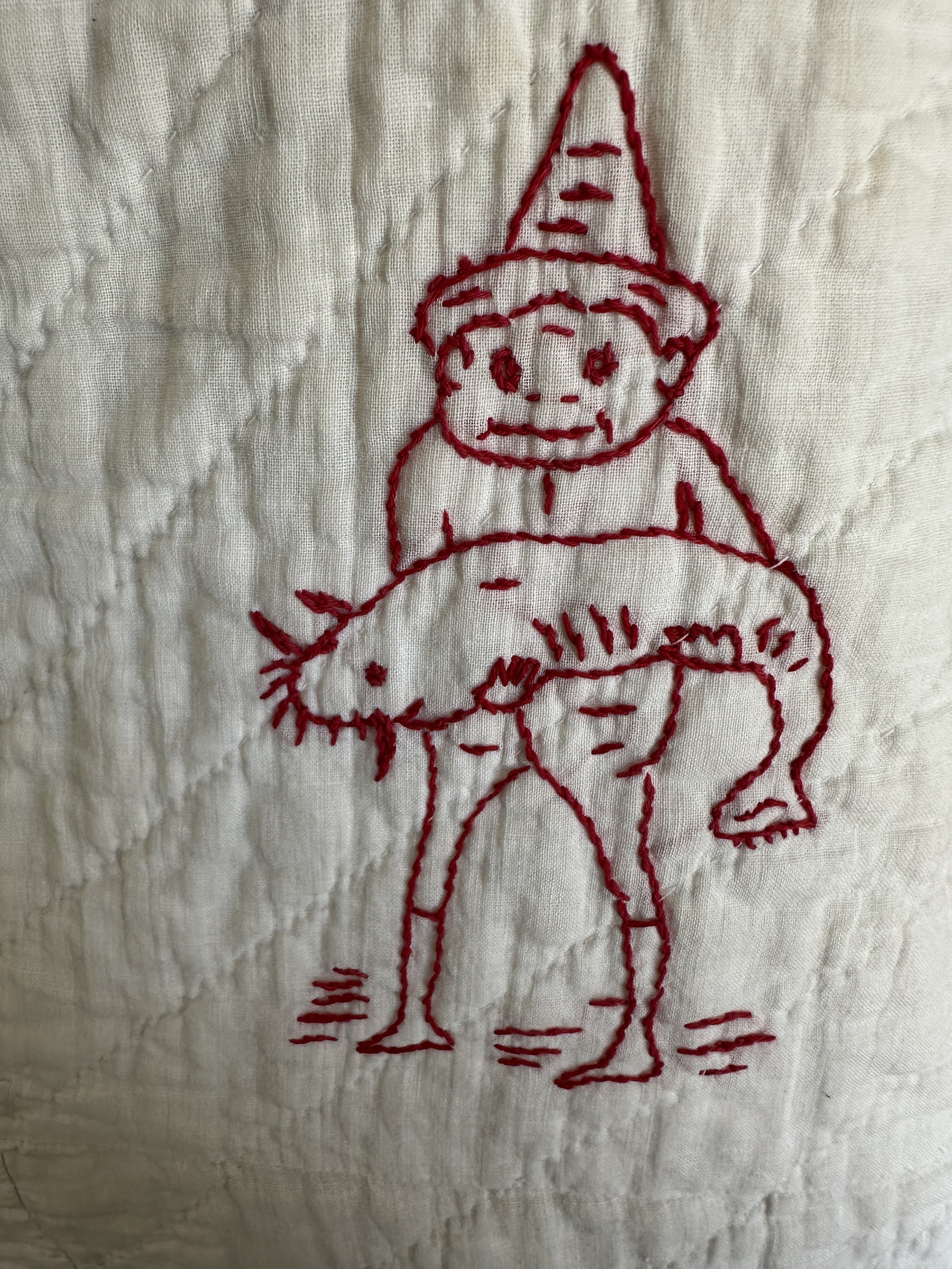
One motif on Beth’s Redwork quilt
Turkey red thread is named for the country where it originated, the recipe for which is still not completely known. What we do know is, it is made from the roots of the madder plant (aka rubia). The process itself is what makes it different from madder red, a similar dye from the same plant. The manufacturing process of Turkey red fabric and thread consisted of multiple steps using oil and it was highly desired by the Europeans because it was bright and colorfast, to name just a couple of reasons. Madder red, on the other hand, used water instead of oil. Jodi Butler, of Quilting Daily, writes that Turkey red fabric involved “bribes, betrayal and industrial espionage…Who knew European textile manufacturers were sending spies to Levant to steal the secret formula?” she writes of the idea that Europeans sent spies to identify and learn the detailed process.1
She goes on to say that because it was so colorfast and didn’t fade (as is evidenced by Beth’s 100-something year-old quilt), and also because the combination of red and cream or white was so ideal, Turkey red had a great deal of influence on quilt making at the time. Turkey red thread is bright and is the result of a unique dying process, that traveled from India to Levant, a region around Turkey and Greece. It took about 17 steps and about 25 days to complete because many of the steps were repeated,
Turkey red thread quilts (aka Redwork, a term that includes decorative needlework) seemed to gain popularity around the late part of the nineteenth century and into the twentieth. As best we can ascertain from her intense genealogical study, Beth’s quilt, which she inherited from her husband Dave’s family, was perhaps completed in the early 1920’s probably by Laura May Evans, who was a teacher at the time and lived from about 1890-1970. Beth surmises that she may have been taught the embroidery techniques by her mother, Maria, and that maybe this was a kind of “practice piece.” The stitching is basic with the common backstitch throughout (formerly known as a Kensington stitch), typical of Redwork quilts at the time. According to Wikipedia, quilt patterns for red thread may have been sold pre-printed by women for a penny apiece as a way of generating extra income.
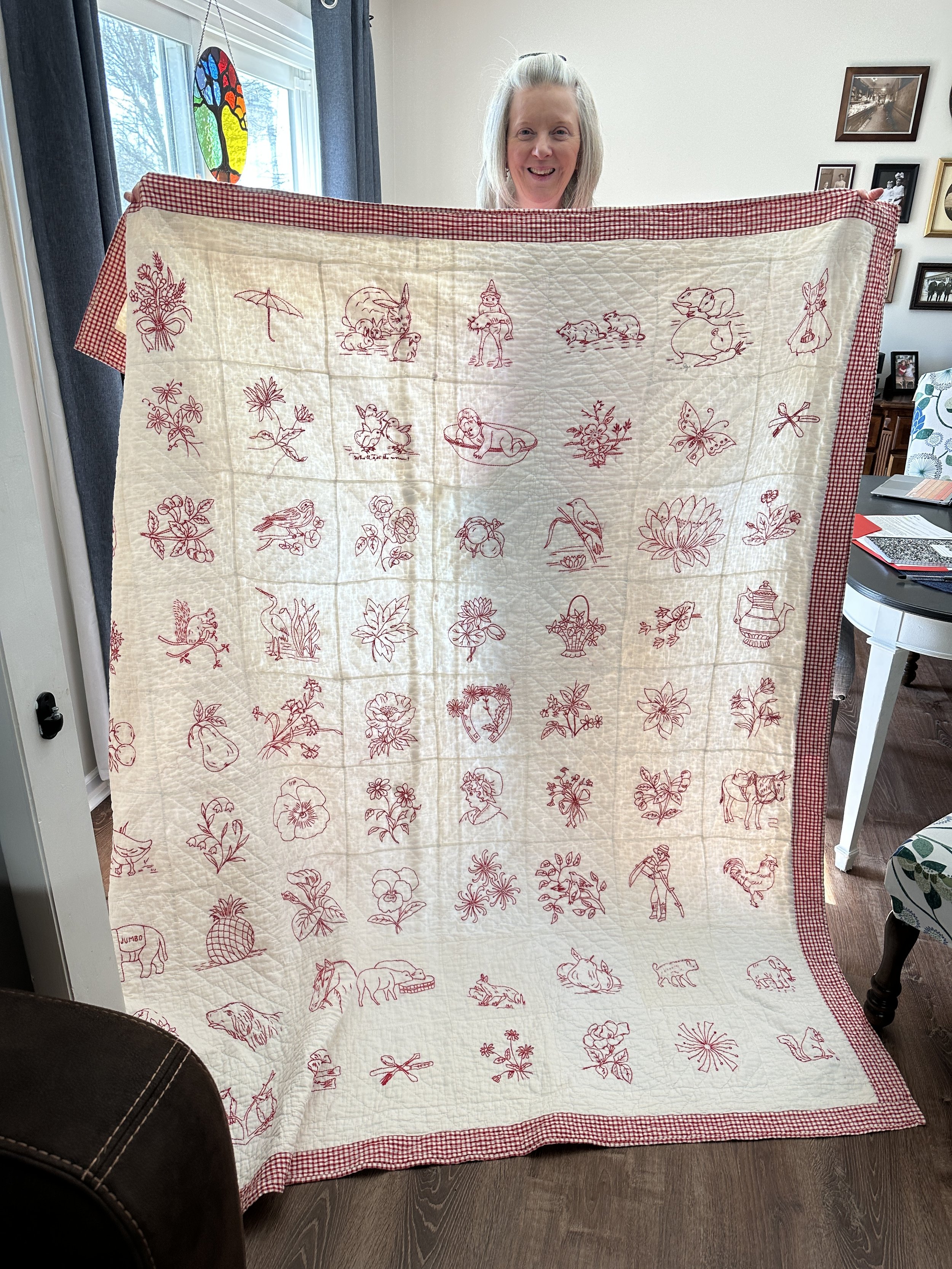
Beth and her Redwork quilt
“What we have is even less than what we make,” says Stephania Gomez2 in her poem Redwork which appears in the May, 2025 issue of Poetry Magazine. “Redwork quilts were not labeled, they were unsigned; quilted anonymously,” (Gomez, 2025). Beth and Dave’s quilt is a testament to the skill and dedication required of a quilter, as well as the time period from which it came. Beth treasures this quilt and has passed it down to her son and daughter-in-law who will hang it proudly in their farm house home. Beth continues to study the genealogy of her own and Dave’s family, unearthing details and answering more and more questions about their ancestors. How fun it would be to know more details about this Redwork quilt and its owners and history!
If you have a quilt story or two to share, please comment below. I’d love to hear them! And if you need help telling your quilt’s story, my book, The Story of Your Quilt might help. It is filled with motivational quotes and inspirational prompts and even a story of one of my first quilts. You can find itl here.
References
1 Butler, Jodi. The (slightly) shady history of red and white quilts. Quilting Daily, http://www.quiltingdaily.com/slightly-shady-history-red-white-quilts/ . Accessed April 8, 2025
2 Gomez, Stephania, April 14, 2025, Redwork With Stephania Gomez (webinar),TextileTalks, International Quilt museum, Accessed April 14, 2025
Redwork: A Textile Tradition in America, Quilt Index, 2008, https://quiltindex.org/view/?type=exhibits&kid=12-91-443, accessed April 28, 2025.
Redwork, Wikipedia, last updated March 28, 2024, https://en.m.wikipedia.org/w/index.php?title=Redwork&diff=next&oldid=1151543634&diffonly=1